 📷 City Limits
'Come Back to Us': Public Housing Residents Press Mamdani to Deliver on Promises - City Limits
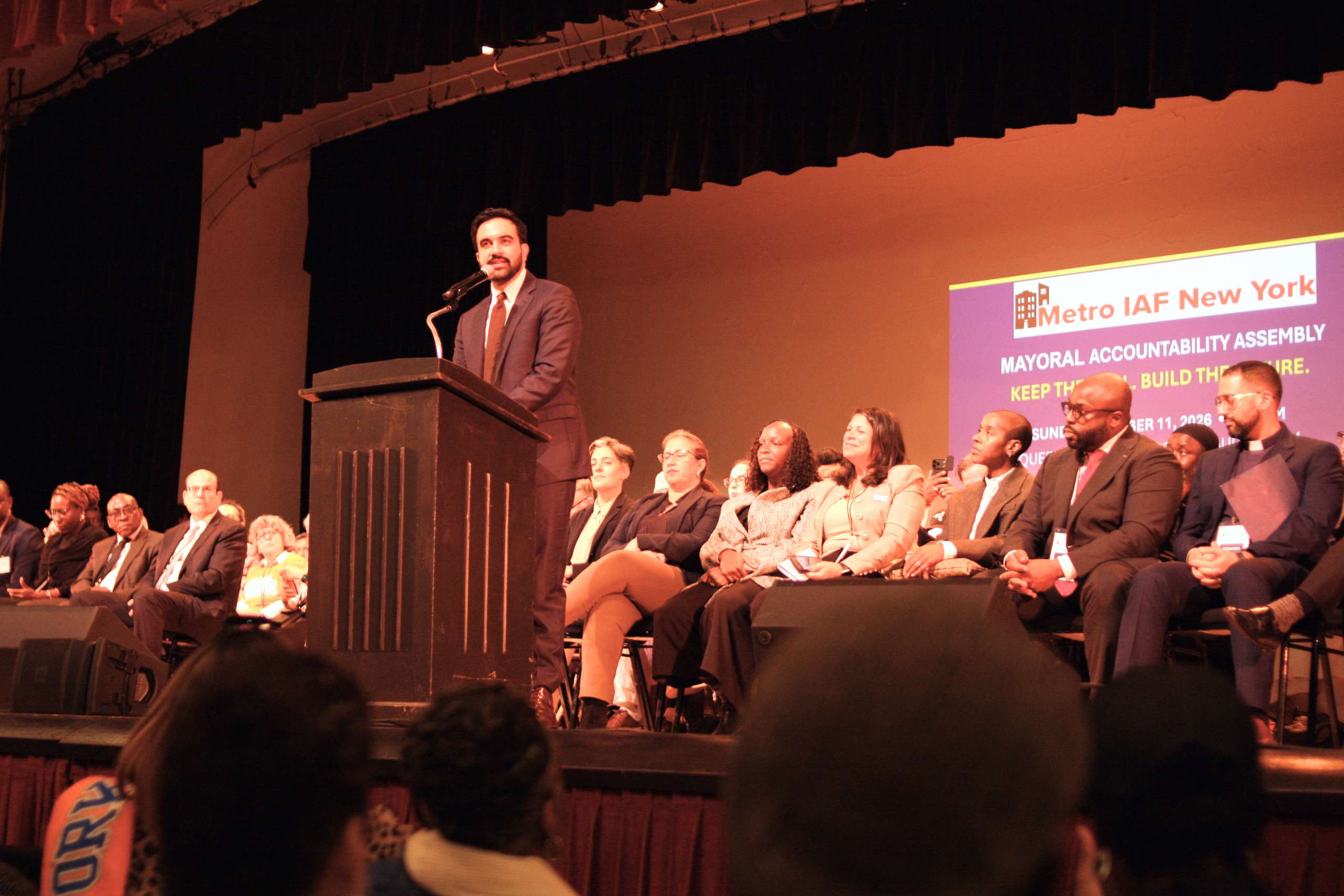
Thousands of public housing residents, community and religious leaders gathered for an "accountability assembly," with Mayor Zohran Mamdani.
Thousands of public housing residents, community and religious leaders gathered for an "accountability assembly," to press Mayor Zohran Mamdani to investigate conditions in NYCHA developments that have converted into public-private operating models, among other priorities.
Jessenia Casiano, a resident of NYCHA’s Pennsylvania-Wortman Houses in Brooklyn, was among the more than 2,000 public housing residents and community and religious leaders who gathered at the Queens College auditorium for an "accountability assembly," with Mayor Zohran Mamdani.
The attendees were there to press him on four community priorities they collectively raised, and Casiano said she arrived with a clear message for the mayor: "Don’t forget Penn-Wortman, Boulevard or Linden Houses," she said. "Come back to us."
Thousands of attendees from diverse neighborhoods and faiths braved a rainy commute to Flushing on Oct. 11 for the assembly, organized by advocacy group Metro IAF, to hold the mayor accountable on promises he made to build affordable housing and improve public safety. Metro IAF held a similar assembly last year with then-mayoral candidates Mamdani and former Gov. Andrew Cuomo.
At this year’s assembly, the mayor agreed to take action on all of the priorities the group raised: creating more mental health crisis centers, building 20,000 affordable homes each year, and expanding models for public housing residents to report critical repair needs.
"I want to acknowledge that the progress we’ve been able to make on this has been because of Metro IAF leaders coming into City Hall with ideas, with drive, with commitment, and that has helped us get to this point," Mamdani told the crowd.
The group also got the mayor to commit to investigating what residents describe as inadequate repair work in three public housing developments that have converted from traditional public housing into a public-private operating model.
The mayor told attendees that his administration is "committed to working with NYCHA," to hold private partners accountable, adding, "and we are committed specifically to also doing so with regards to the performance issues at Linden, Penn-Wortman, and at Boulevard."
"That’s all we needed," Casiano said. "This is the first time someone in leadership and in authority has decided to work with us in that way, and we’re willing to work with the mayor."
Holding private partners accountable for unfulfilled repairs
For about a decade, the city has been using the Permanent Affordability Commitment Together (PACT) program to turn thousands of public housing developments over to private developers as a means to raise repair money.
Under the model, the New York City Housing Authority (NYCHA) continues to own the buildings and land, while private management companies take on operations and fund extensive repairs—upgrading heating, plumbing and elevators, and renovating apartments, common areas and windows.
Mamdani allocated $5.6 billion for NYCHA in his housing plan released in May, and just less than half of that will funnel into two funding tools, namely the PACT program and the Public Housing Preservation Trust , that the housing authority uses to convert its developments from traditional public housing under the government’s Section 9 program to another federal program called Section 8. This enables the housing authority to receive up to twice as much in federal subsidies. The PACT program on-boards private partners, while the Trust is a public entity that can issue bonds to raise funds, and was created in 2022.
The strategy has faced opposition from NYCHA residents who oppose the involvement of private developers in public housing , and Mamdani's support of PACT has earned him the ire of some tenant leaders .
NYCHA, however, refers to the PACT program as one of its "most successful tools for modernizing its aging housing stock and providing a better quality of life for NYCHA residents," as it enables the housing authority to qualify for larger federal subsidies, and also secure funds to repair its aging buildings—where decades of government underfunding has fueled deteriorating conditions.
News and civic updates are curated for public community information. AI168 maintains an objective, non-partisan platform.← Back to News